RISA CEO Highlights Rwanda’s AI Policy and vision for Africa’s digital future at MWC Kigali 2025
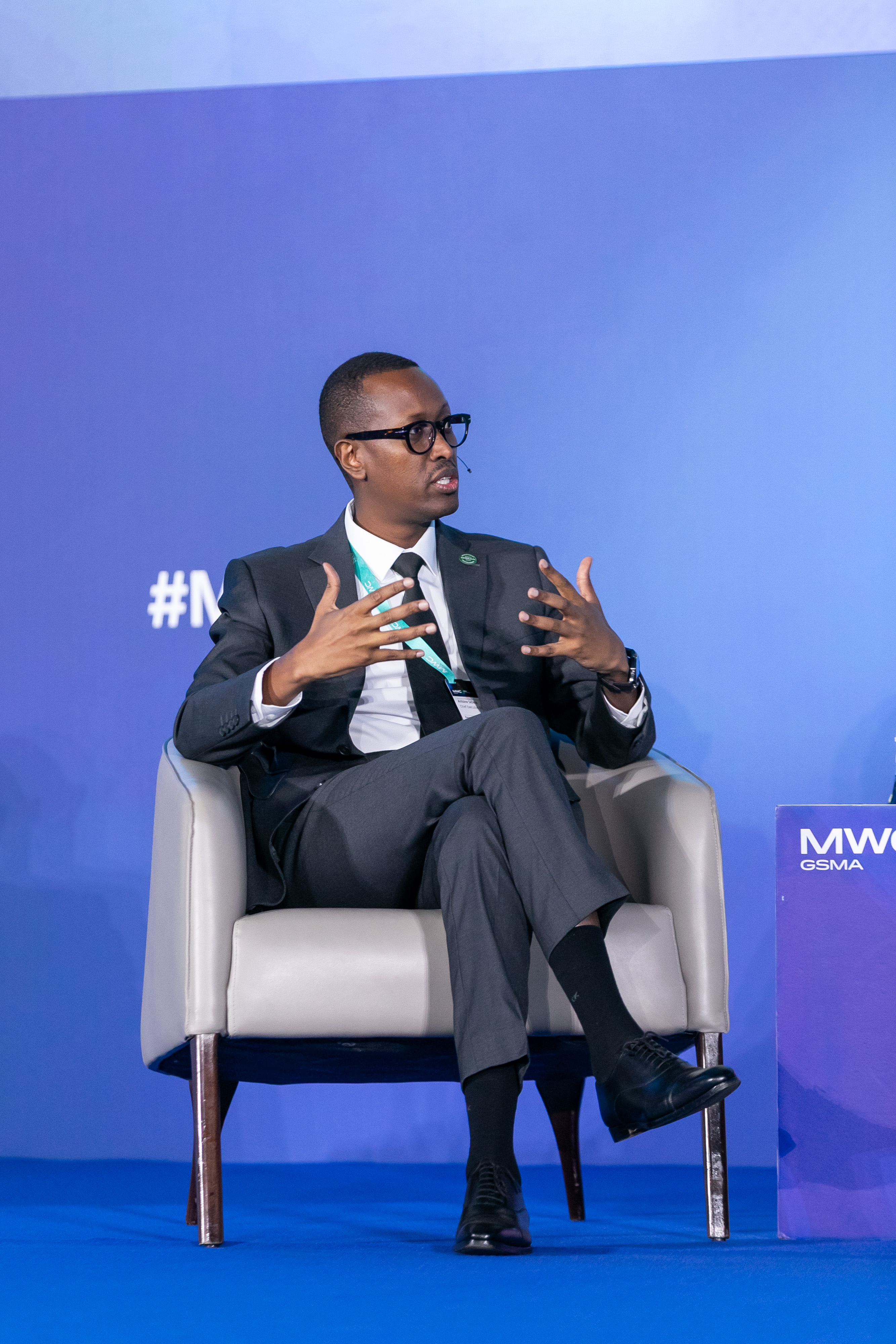
At the Mobile World Congress (MWC) Kigali 2025, RISA Chief Executive Officer Antoine Sebera joined leading experts in a high-level keynote panel titled “Networks that Think: Harnessing AI for Scalable Telecom Growth.” The session explored how Africa can leverage artificial intelligence (AI) to unlock economic potential, drive innovation, and deliver inclusive digital transformation.
The panel, moderated by Lara Dewar, Chief Marketing Officer at GSMA, featured Kate Kallot, Founder and CEO of Amini, and Antoine Sebera, CEO of the Rwanda Information Society Authority (RISA), among other thought leaders from across the continent. The discussion explored the role of Artificial Intelligence (AI) in powering telecommunications and enabling smarter, more connected societies.
In his remarks, Mr. Sebera shared Rwanda’s journey and strategic approach to building an AI ecosystem rooted in trust, inclusion, and sustainability. He highlighted that Rwanda’s National Artificial Intelligence Policy is designed to ensure the country fully benefits from the opportunities that AI presents. The policy focuses on four key pillars; skills development, infrastructure, governance, and collaboration all aimed at fostering a strong and adaptive AI ecosystem.
“Our goal is to build an AI environment that not only accelerates innovation but also empowers citizens and businesses to participate meaningfully in the digital economy,” said Mr. Sebera.
He explained that the policy also emphasizes collaboration between government and the private sector, encouraging co-creation of AI use cases that address local challenges in health, education, agriculture, and public service delivery. Rwanda’s commitment to data sovereignty and ethical AI use underpins its broader vision of inclusive, human-centered digital innovation.
During the discussion, Kate Kallot stressed the importance of building AI for Africa, by Africans developing technologies that respect local contexts and realities, such as connectivity and energy constraints, while upholding data sovereignty. She underscored the need to transform fragmented analogue data into AI-ready datasets, expand micro data centers powered by renewable energy, and develop foundation models trained on African data.
The panel also addressed Africa’s connectivity gap, with nearly one billion Africans still unconnected. Participants noted that infrastructure sharing among telecom operators, AI-native investments, and digital literacy programs, such as Rwanda’s Digital Ambassador Program (DAP), are essential to ensuring AI reaches all citizens and communities.
Mr. Sebera emphasized that AI should not be seen as a distant or isolated innovation, but as a practical enabler of better service delivery, efficient governance, and local innovation. He noted that Rwanda’s investment in digital public infrastructure, data-sharing frameworks, and digital skills development provides a foundation for the country’s AI ambitions.
Panelists also highlighted Africa’s leadership potential in responsible AI innovation, including edge computing and “tiny AI” models optimized for resource-constrained environments. They called for regional collaboration to harmonize AI legislation, share datasets, and nurture skills across borders, fostering a continental AI ecosystem capable of driving scalable, sustainable growth.
Looking ahead, the discussion envisioned a future in which African-built AI solutions will not only transform sectors like health, education, and telecoms but also be exported globally demonstrating Africa’s capacity to lead in ethical, efficient, and contextual AI.
The session concluded with a shared vision: Africa’s AI future depends on collaboration between governments, the private sector, academia, and communities, to ensure that no one is left behind as the continent builds smart, scalable, and inclusive digital economies.
